Thursday, June 14, 2007

The True Story of Clinton's Assassin


March 5, 2000 – Billy Cox - FLORIDA TODAY

NO CRUELER TYRANNY


Last December, on the day President Clinton swung into Orlando for a fund-raiser, a man convicted of threatening to gun him down was getting a more dubious red-carpet treatment.

Escorted by four federal suits, 52 year old Ronald Barbour spent an all expense paid evening in a downtown Holiday Inn, with supper and breakfast billed to Uncle Sam. Talk about VIP privacy – Barbour's hosts blocked off the entire fifth floor, just for him.

But there were a few nonnegotiable strings attached. Barbour couldn't go anywhere. He couldn't make long distance phone calls. He was required to sleep with his bedroom door open. Furthermore, the Army veteran had to watch his mouth about the man he loathes.

"What did I say?" repeats Barbour, when asked to retrieve the exact words that put him in prison for four years. "Well, after all these years I can't recall my exact words concerning Clinton, but they were to the effect that he was a draft dodger and whoremonger. I would note that I was merely repeating what was said about Clinton by a high-ranking military officer who was forced out of the service for saying them."

Barbour's words coupled with a trip to Washington, D.C. in 1994 with an allegedly loaded gun have earned him an active file in the Secret Service's list of potential assassins. As a consequence, the former retired Army career soldier and right wing political activist is being watched by the Treasury Department's crypto-agency, which knows virtually every move he makes.

The Secret Service won't say how many people like Barbour it tracks: This much is certain: If all the world is a stage, the former Army Intelligence officer has the role of a lifetime. "In terms of Shakespeare, I feel like Hamlet, being stalked by the King and his men."

Now living in Orlando, about two years into a three-year probation, Ronald Gene Barbour's rendezvous with infamy has a number of potential origins. Maybe it started when he was a kid, growing up in Huntington, W..Va., reading books such as THE DECLINE AND FALL OF THE ROMAN EMPIRE, THE RISE AND FALL OF THE THIRD REICH, THE FIRST CIRCLE, FAHRENHEIT 451 and NINETEEN EIGHTY-FOUR. Maybe it started with his Cold War under cover intelligence duties in Berlin.

So far as the government cares, it started on January 29, 1994, when a neighbor secretly and illegally tape recorded a conversation Barbour and his brother was having over beers. The neighbor, Stacy Harris, said he did it after hearing Barbour allegedly talking about an attempt to assassinate President Clinton.

Harris was later given a $100,000 reward by the Federal Government for his tape recording. In May 1994, a federal jury in Orlando heard excerpts from the tape. Barbour later challenged the admissibly of this recording on the fact that it lacked a chain of custody (The recording was made on January 29, 1994 - Yet it was not turned over to the Secret Service until a week later) and that it had been edited. Barbour notes that anyone can be made to say anything after a tape recording has been modified.

Hence, the jury heard Barbour's alleged graphic antipathy toward Bill and Hillary Clinton: "And Hillary," the tape has Barbour saying, "You know, I never thought about beating a woman before, but I had this vision, of just stomping her to death. I'd go for her throat and try to break her neck real quick because she's a little thing, and then finish the job by stomping her body with hobnail boots." A few moments later, Barbour allegedly told Harris to get his autograph, because "I'll be the guy who shot Clinton."

Barbour thinks that this portion of the nearly three hours taping by Harris (Only several minutes were turned over to the Secret Service) related to a joke to his brother concerning the punishment of his pet dog (a female) who had a problem with making messes in the house. In regards to the alleged threat about Clinton was a "cut and paste" job done by the Secret Service, because in the original recording transcript no threat against President Clinton is recorded.

Secret Service agents who interrogated Barbour without reading him the Miranda Warning said that Barbour was allegedly drinking heavily and depressed in the winter of 1994. At that point, feeling that life was slipping away and that he had nothing to lose and that he had a political score to settle, Barbour drove north to Alexandria, Virginia from Orlando, Florida and checked into a motel. The Secret Service agents said that Barbour was armed with a Colt .45 caliber automatic pistol and more than 100 rounds of hollow point ammunition. While at the motel for a week, the Secret Service thinks that Barbour made at least six trips into Washington, D.C. looking for President Clinton's jogging routes, so that he could set up an ambush. After learning that the president was in Russia, Barbour returned to Florida without the accomplishment of his "mission."

Barbour relates a different account of his January 1994 trip to Washington, D.C. "Bill Clinton was the last thing on my mind. At that time I was a limo driver for Mears Transportation. I took a week's vacation to visit Washington, D.C. to check out the job opportunities for a person in my line of work. I also wanted to visit the memorial to those who died in service of their country during the Vietnam War. I have a few friends named on that memorial. Yes, I did have a weapon with me for personal protection, but it remained locked in the trunk of my car and unloaded. In regards to me not knowing that Clinton was in Russia during the week I spent in the Washington, D.C. area, all I can say is that I'm a news hound – Of course, I knew he was in Russia! However, as I've said before, I was not interested in harming the president."

Despite the obvious weaknesses in the Government's case against Barbour, a federal jury in May 1994 convicted him of 18 U.S.C. 871, formally known as "Threatening the Life of the President of the United States," a felony that carries a five-year sentence with a possible $250,000 fine, although rejecting 18 USC 1751 known as "The Attempted Assassination of the President" which would have carried life.

Barbour points out that the Government committed major constitutional violations in his case: Perjury, suborning perjury, deception, falsification of official documents, unlawful modification of an audio tape used as evidence in court, intimidation of witnesses by federal agents, obstruction of justice, violation of Writ of Habeas Corpus and other criminal violations. Also, no witnesses observed him on the Mall or near the White House.

When asked in reason for the jury's decision against him Barbour thinks that it was based on emotion, "The U.S. Attorney's attitude, and one that he was successful in selling to the jury, was so what if the case against Barbour was far from perfect, he was going to assassinate the President. In other words, he couldn't prove it, he just said it and that was good enough for the jury."

Barbour spent four years and three months in various federal prisons. He walked out on June 26, 1998, unchastened and insisting that his conviction was politically motivated. The U.S. Supreme Court disagreed and denied his appeal in 1995.

STAR CHAMBER JUSTICE

"Our system of justice has many ominous parallels with the star chamber of yesteryear: Decisions are made behind closed doors and the average citizen isn't entitled to know anything about the process," Barbour charges, "For instance, after numerous Freedom of Information requests I cannot find out anything on how the Secret Service determines who constitutes a threat against the presidency. If you're able to discover anything will you let me know? I've been trying to find out for years."

Replies Secret Service spokesman Jim Mackin in Washington: "That not something we share. We don't talk a lot about protective intelligence."

But on February 9, 1994, an inadvertent glimpse of insight came from agency psychologist Margaret Coggins.

Lecturing at the University of South Florida's Mental Health Institute, Coggins told listeners the Secret Service had three classifications for threat assessment. Those in Class I, she said, are discarded as no threat. Class II involved suspects who were investigated and determined not to pose a threat. Class III types, Coggins said, are considered legitimately dangerous.
At that time, there were 120 Class III suspects in America. Ronald Barbour was not one of them. Coggins didn't mention Barbour's name in her lecture, but she spoke of a Florida man who had been questioned by Secret Service agents on February 3, 1994 — the same day that Barbour was contacted by the authorities.

"The subject went to the Mall every day for six days waiting to shoot the president," Coggins told the audience. "He hoped that if he shot the president, he would be shot dead himself. Fortunately, the president was overseas at the time."

Coggins, whose remarks were printed in the St. Petersburg Times, informed listeners the suspect had been interviewed and eliminated from Class III consideration. So, what happened between then and February 17, 1994, when Barbour was indicted on federal charges by a Grand Jury?

Mackin said Coggins wouldn't be available for comment, "We're, uh, well aware of that article," he says, "I'm not sure she knew members of the news media were at the Conference."
Furthermore, threat assessment evaluations are privileged information. "It goes to our methods and means," he says. "We receive cases involving threats on a rather consistent basis, and we investigate them all to the fullest. If a defendant knows how it's done, they might be able to manipulate the process."

Barbour thinks that President Clinton got directly involved with his case. He cites a reference in the Government's Sentencing Memorandum to a meeting Clinton had prior to the indictment with then Secret Service Director Ron Noble.

"Well, what else could it be but political?" says Barbour who has requested the minutes of that meeting under the Freedom of Information Act, so far, to no avail. "The State of Maryland prosecutes Linda Tripp for illegally taping Monica Lewinsky, but the guy who does the same thing to me gets off scot-free. Come on – give me a break."

Clarence Counts, who represented Barbour at the District court trial and Appeals to the Federal District Court and the United States Supreme Court, states that Stacy Harris' taping was a felony under the Florida Statutes, which mandate a five-year prison sentence for a violation.
The prosecutor of Barbour, former U.S. Attorney James Glazebrook, appointed by President Clinton to the office of U.S. Magistrate Judge for the Middle District Court in Orlando recalls prosecuting Barbour and doesn't dispute Count's point concerning the Harris tape. "It was a very interesting case," he says.

"I remember, at that time, feeling 100 percent confident that no state attorney would think of prosecuting Harris for turning over a tape that might have saved the life of President Clinton," Glazebrook says. "The court completely and properly rejected the defense arguments, because Harris was a Patriot."

Barbour thinks that both Harris and Glazebrook are about as patriotic as Benedict Arnold.

INCRIMINATION

Barbour says that the Secret Service investigators were unable to produce eyewitness accounts to build a case of presidential stalking. Therefore, they tricked him into incriminating himself, in an interview done without benefit of the Miranda Warning, by walking him through a series of hypothetical questions like, "What advice could you give the Secret Service to enable it to better protect the president?" He says that never in the course of the five-hour interrogation did he tell investigators that he planned to assassinate President Clinton.

Without knowing the particulars of the case, ACLU executive director Greg Nojeim in Washington, D.C. says that it's difficult to know where Barbour crossed the line from First Amendment rights to a deadly threat.

As for the Secret Service's classification procedures, Nojeim says: "Good luck. Your only hope of finding out how he went from Class II to Class III is to file under the Freedom of Information Act and wait a few years and hope you're satisfied with the results, because they're usually not satisfying."

With the Linda Tripp analogy in mind, Tim Lynch, spokesman for the Cato Institute, a Libertarian think tank in Washington, D.C. says, "Prosecutors have an extraordinary amount of discretion. You can take any two cases in the country and say, ‘Why this and not that?' And because there is so much discretion, cases like these do raise legitimate questions of oversight involving the legislative branch over the executive."

Having exhausted all legal recourse, those discussions are a moot point for Barbour, now, but given his background in military intelligence, Barbour wonders whether he'll be on the government's "Watch List" for the rest of his life, "Can you believe it? The Secret Service considers my military career a negative factor in my case."

MILITARY CONNECTION

The adopted son of a World War II veteran who landed in France at Omaha Beach on June 6, 1944, Barbour joined the Army after high school in 1966. He served tours of duty in Europe, Southwest Asia, Southeast Asia and Alaska before being assigned covert "spy duty" in West Berlin working a cover electronic surveillance mission against Russian forces in East Germany from a radio tower.

In the late 1970s, Barbour was assigned to the very secret National Security Agency at Ft. Meade, Maryland where he worked the ELINT mission, which was the intercept and analysis of Russian and Chinese telemetry and radar systems. In the early 1980s, Barbour was assigned to the Canal Zone in Panama to monitor Cuban and Russian signal traffic to and from Central America. Barbour retired from the Army in 1986, after his last assignment at Patrick USAF Base, Florida.

THE FEDERAL PRISON SYSTEM

Barbour says he pulled time at four federal prisons. The most memorable was a year spent at Butner, North Carolina, in 1994 where he meet Jonathan Pollard, convicted of spying for Israel and Keith Idema, convicted of fraud and a self styled "Soldier of Fortune" who alleged that his conviction was a frame up by the federal government who wanted his information concerning portable nuclear weapons. Barbour's impression of Pollard was that he was an honest man sorry for his offense against national security. In contrast, Barbour thought Idema was a liar and phony who had puffed up his resume in Special Forces and lied about his experiences in the former Soviet Union. Barbour notes that Idema spent most of his time at Butner in Segregation because of his many problems interacting with guards and fellow inmates.

Barbour says that he was assaulted twice by fellow inmates while incarcerated, but says that his injuries weren't serious. Barbour also states that he was closely monitored by prison authorities, subjected to endless interrogations by Secret Service agents, and that prison authorities encouraged fellow inmates to spy on him.

When freed in 1998, Barbour says that, "I had always been a free man in my mind, so a readjustment to life outside prison was extremely easy for me."

THE BARBOUR CASE: IMPORTANT QUESTIONS NOT ANSWERED

"In the present case, Barbour "was not just making idle threats." Hines, 26 F.3d at 1474. Less than two weeks prior to his threats, Barbour was in Washington, D.C., with one hundred rounds of ammunition, waiting to assassinate the President. He failed to carry out his plan only because the President never arrived where Barbour was waiting, and he returned home only after discovering the President was out of the country. Barbour never deviated from his plan to kill the President; he was just denied the opportunity. Thus, when Barbour made his threats after returning home, there was every reason to conclude that he intended to act on those threats and that he was likely to do so. Because the record supports the district court's determination that Barbour had evidenced an intent to carry out his threat, the six- level enhancement pursuant to U.S.S.G. § 2A6.1(b)(1) was properly applied." - Federal Curcuit Court Judge Kravitch.

This reporter would like to ask the following questions to Judge Kravitch after careful examination of more than 1,000 pages of pictures, tapes and court records relating to this case:

1. If indeed this account is true then why was Barbour not tried in Washington, D.C., the site of the alleged assassination plot?

2. Why the Government could produce no witnesses or pictures to place Barbour anywhere near Clinton's jogging routes where the alleged assassination was to take place?

3. Why does Judge cite "100 rounds" of ammunition and gun ownership come from when it was proven in court that Barbour owned no guns or ammunition at the time of his arrest?

4. Finally, Clinton was not in Washington, D.C. and on a tour of Russia during the alleged assassination attempt, so how could have he been harmed by Barbour in Washington, D.C.?

NO CRUELER TYRANNY: THE INJUSTICE OF THE BARBOUR CASE

This reporter thinks that a great injustice was done to Barbour. Please consider the facts of the case that were exposed in court:

1. The information that Barbour had attempted to assassinate came from a confidential informant not trusted by law enforcement agencies because the information he provided to authorities was not reliable and used to settle personal disputes with others.

2. The agents discovered in the course of their investigation that Harris had produced a recording that was clearly illegal under federal and state statutes and should not have been admitted in court, because it lacked a chain of custody, but was allowed by the District Court based only on the testimony of Harris of its accuracy.

3. President Clinton was briefed by Ronald Noble, the current Director of the Secret Service, on or about February 4, 1994 concerning the arrest of Barbour for an assassination attempt. The repeated attempts made by Barbour to secure the minutes of his meeting between Clinton and Noble from the White House have been denied the citing National Security.

4. Barbour was denied his right to WRIT OF HABEAS CORPUS for a period of two weeks --February 3, 1994 to February 17, 1994-- despite several attempts by Barbour to secure the attention of the federal judiciary.

5. The District Court ignored perjury on the part of Secret Service agent John McKenna who first interviewed Barbour at the VA Clinic in Orlando. Barbour has testified that he was not read his Miranda right to remain silent, and Barbour’s testimony is supported by the Director of the VA Clinic in Orlando who overheard the conversation from another room. The agents also failed to record Barbour's alleged permission to answer questions or to obtain his signature on a waiver; yet both agents testified that they had these items available in their government vehicle.

6. The decision of the District Court should have been reversed by the majority Circuit Court of Appeals on any of these grounds, which are gross violations by the government of a citizen's rights under the 1st, 4th, 5th, 6th and 14th Amendments, violation of Writ of Habeas Corpus, and indications of a conspiracy to convict an innocent man that may reach into the highest office in the land.This reporter can only conclude from his study of the facts of the case that the federal justice system underwent a meltdown in the Barbour case. In the words of Montesquieu, "There is no crueler tyranny than that which is perpetrated under the shield of law and in the name of justice." It is chilling that some of those individuals responsible for this injustice still occupy positions of authority in the federal criminal justice system.

A TALE TOLD BY AN IDIOT

"I was there at the party where Ron was taped by that Stacy Harris character and I heard the tape in court, and I can tell you my brother never said those things about killing Clinton and an assassination attempt," says Jack Barbour. "And I told that to the court. My brother got screwed big time by Bill Clinton. Everyone knows he uses the courts to get people who don’t like him! Clinton was impeached by the House of Representatives back in 1998 for perjury and obstruction of justice. There is not a doubt in my mind that either Bill Clinton or one of the lackeys got my brother sent up the river. Did Ron tell you he lost everything: his military pension, his apartment, his car, his bank account...EVERYTHING? And for what? Telling the truth about that degenerate and traitor, Bill Clinton. I detest Bill Clinton. I hate Hillary Clinton. I think the Democrats are filthy lying leftist elitist scum and the main enemies of the Republic. So send me to prison for four years too!”

"Ron is not a physical threat to anyone, says Scott Ellis, Brevard County Commissioner, I’ve known Ron Barbour for years. He helped out in my Congressional campaign in 1986. Barbour is politically astute enough to know that shooting the president doesn't effect political change. I think this injustice shows how a corrupt president can bend the federal court system and the Secret Service to do his will. Did a conspiracy exist between Ron Noble, the Director of the Secret Service and Senior Special Agent John McKenna to put Ron Barbour in prison at the orders of President Clinton? I understand that while Clinton was Governor of Arkansas his enemies were sometimes hauled into court on bogus charges. I well recall that in 1995 or 1996 that Rush Limbaugh’s radio studio was raided by the Secret Service because Limbaugh was alleged to have threatened Clinton and they were looking for an audiotape to prove it. The Secret Service found nothing and Limbaugh was not charged.”

“I was a juror in Barbour’s trial at the Federal Courthouse in Orlando in late May 1994,” said Shelly Jackson of Altamonte Springs, “There were two counts on his indictment: The first was U.S.C. 1751 – the attempted assassination of the president; the second was U.S.C. 851 – threat against the president. We found Barbour guilty of the second charge, which carried a five-year sentence. This happened because one juror – the Foreman – wanted to find Barbour guilty of both counts and the rest of us thought he was innocent, so this was a compromise. The deliberations went on for nearly three days and the best reason the Foreman who thought Barbour was guilty could come up with was that Barbour would not have been charged by the government with this crime if he was not guilty. At least Barbour was spared the worst fate in our verdict because conviction on U.S.C. 1751 would have carried life in prison.”

“I was Ron Barbour’s attorney in the trial and wrote both his appeals,”says Clarence Counts,” I have been an attorney for more than 20 years and handled dozens of clients and have forgotten most of them; however, the USA v. Barbour is one case I’ll never forget because of arrogant abuse of power and obstruction of justice on the part of the U.S. Secret Service which resulted in sending an innocent man and honorable decorated professional soldier to prison for more than four years. I remember thinking several times during the trial of Barbour that what was happening to him had an ominous parallel with the oppression of political opponents of the Communist regime in Soviet Russia like Nobel Prize winning author Alexander Solzhenitsyn. Did Ron Barbour attempt to assassinate President Clinton? The facts of the case indicate he did not; therefore, the Circuit Court majority opinion by the very liberal and Democratic appointed Judge Kravitch in the denial of Barbour’s Appeal is a tale told by an idiot.”

Comments -

painfulpuptent4anncoulter said...

That's an interesting article Ron. Your case is a very troubling example of prosecutorial over-reach. I can't believe they found you guilty and you had to go to jail. Shit, you didn't do anything. Somebody simply thought you 'might' do something and wham, with the help of an agressive prosecutor and a careless judge you're in the clink. Wow.

You've put up with a lot of shit and yet you still love this country. You a big man to be able to move on, a helluva lot bigger than those who prosecuted you.

January 07, 2006 12:53 AM

Ronald Barbour said...

Thanks for the kind words!

Like Nietzsche said, "That which does not destroy us makes us stronger."

February 19, 2006 7:21 PM

VOLK said...

That was pretty supportive of Ronbo. A few CYA moments, but pretty supportive overall. Having been in law enforcement, it isn't a stretch to understand how the SS feels that Ronbo is the mother of all bad guys (after all, they couldn't be wrong, right?), and it makes sense that some in the SS will choose to make bagging Ronbo again their life goal.

I find it to be abusive at best though, when someone has "paid" the full penalty for a conviction, and still has to live with a government microscope up his ass years later.

I like Ronbo. I buy his side of the story. Even if he shot his mouth off in the wrong place, at the wrong time, I can't picture him as a presidential assassin. There are a couple of reasons.

First, his track record over the years is extreme (as fits the forum), but he supports rule of law. Shooting a president is plain wrong, as even in the case of Clinton, he was elected by the people, and if you happened to be on the losing side, you bear with it until times change. Murder isn't an acceptable response to losing an election. Politics is what it is, but it isn't a capital offense to have more people support you than the other guy, even if many of the people who support you are pretty much a sackfull of ignorant morons, as was the case with Clinton . Murdering a president of any party is to deny the basic foundation of the rule of law in the US, and there is no way to justify such an act as a 'positive' event in our history.

My second thought is that any attempt on the life of a US president would end up offering the party of the president a great boost at the expense of the minority party. Clinton is a lot of things, but he isn't the whackiest member of the US communist party. Most of the real whacky members of that party are in the Senate. They would have filled the void, and used the murder to gain public support for years to come. In that case, the US would be busy picking up where the CCCP left off, even faster than it is today.

Unless Ronbo suffered from a bout of insanity at the time, I think his political acumen is such that he would never go through with such a fucked up plan.

March 15, 2006 11:11 PM

Apache said...

Nice write up Ronbo!

I keep getting asked by other bloggers why I don't start my own blog and occasionally I think about it but having to write about something semi-deep and relevant while being entertaining and sometimes funny all at the same time just seems like something too close to work to me.

Besides, I would much rather read what everyone else here has to say.

To me that is far more interesting.

Also, what puts the hand cuffs of social correctness on some of these other bloggers is there very own success that they seek. Then their blog takes off and becomes profitable then they start worrying how they appear to others on their next MSNBC interview, or if their advertisers will freak and stop advertising and so they worry more and remove all of their links to places like this that are not that different from when they started out.

By now I understand and I find it funnier than it hurts me, but now I understand.

It like their blog is growing up and they are leaving home in a way; it's a sign of success and that is something I ultimately wish for everybody.

March 15, 2006 11:18 PM

Anonymous said...

To put it in Monty Python terms: Barbour is a loony.

March 15, 2006 11:28 PM

Ronald Barbour said...

Loony?

This is hard one to disprove -- after all, how do you define "sanity?" Certainly many people have said Bill Clinton is totally insane, yet he was twice elected president. Many believed Ted Kennedy was totally loony when he killed that woman back in 1969. What about Howard "Rant" Dean? If indeed I am insane I'm certainly very clever because I fooled the U.S. Army Security Agency into giving me a security clearance well above Top Secret for a number of years. I also fooled everyone in my chain of command in the Army for many years into giving me promotions, letters of achievement and decorations. Ditto four years in prison. Ditto eight years outside prison.

The truth is that I'm about as insane as HAMLET. A classic story that has many parallels with events in my life.

In my case from the very beginning in early 1994 it was the goal of the Secret Service to have me judged insane -- but even the BOP doctors at FCI Butner could find nothing wrong with me other than mood swings -- someetimes I'm happy and sometimes I'm sad. Very strange indeed.

After my release from prison I talked the VA into another mental analysis and the results were the same: I am sane. This was the same result of the analysis by a court appointed doctor before my trial.

Therefore, I was sane before the trial, sane during my prison experience and sane today.

It is interesting that the U.S. Secret Service treated me the same as political prisoners were treated by the KGB during the glory days of the Soviet Union. It must be admitted this is a very effective tactic in the area of public relations, because the MSM immediately jumped on the bandwagon and used this canard as an effective way to destroy a conservative.

I would compare my case to the Dreyfus Affair in France.

In case you're wondering the Secret Service considers me still a "Class III" suspect and I have a Case Officer who follows me all over the Internet reading what I post.

I understand the S.S. worries that a veterans' group, conservative group, or conservative publication/personality will take up my cause and force this injustice back into court.

My most recent encounter with the S.S.

So in conclusion fellow citizens, soldiers, patriots and veterans: After reading the articles pro and con about Barbour: vote on it!

1."Barbour insane?" Yes or No.

2. "Barbour guilty of the attempted assassination of President Clinton?" Yes or No.

3. "Barbour should get a DE NOVO review of his case?" Yes or no.

4. "The Government should release all documents regarding Barbour's case?" Yes or no.

March 15, 2006 11:41 PM

Luckygear said...

Saying your going to do something is not the same as doing it. If you did't do it, your not guilty.

Basically, this man, suffering from severe stress, made threats to stop what he supposed was the leader of a degenerate population of people who ruined his country.
The corrupt system wanted to prove to itself that it controls everything and everyone, to allow itself to feel secure despite its burden of guilt and the intense hatred it knows it deserves from the non-system population.

Therefore, despite the man having mental problems, it seems he was not placed in an institution for the insane, but PRISON, because the system felt that despite his insanity his intended actions were in effect perfectly sane and to be expected. Thus the system is aware of its guilt, but is itself sociopathic and only considers itself clever for continuing its criminal (and un-Constitutional) actions unchecked. That's a fair definition of evil.

He may be crazy, but at least he has some patriotic thoughts about saving his country, unlike these SF mercenaries who get paid to play the tough guy, going to foreign lands to kill untrained civilians for money and glory.

And if you really believed he was insane, why would you be so defensive about it, reaffirming how elite you are on a messageboard while discrediting him?

I'd guess you don't believe he is insane, just made threats to a system that calls you elite and glorifies you, and that really seems to piss you off.

Kinda like cops who seize guns from citizens so they can feel needed, when they are really the enablers of the legions of petty and serious criminals that stalk our cities.

If you do believe he's insane, then you must also be insane to feel threatened by his remarks. If you become an accomplished person outside of institutions like the military, you will realize an inner worth that needs no artificial support structure provided by a berets, uniforms, lingo, credos, tats, and medals.
With such confidence, you will not feel threatened by people who cannot control their emotional extremes, and you will become empowered to control yours.

March 15, 2006 11:50 PM


Sunday, June 03, 2007

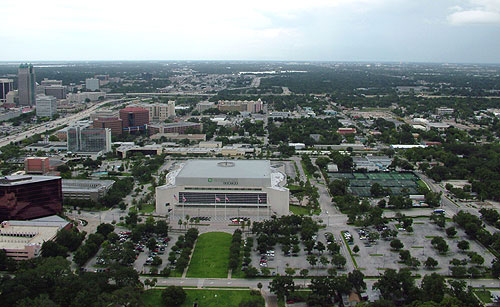
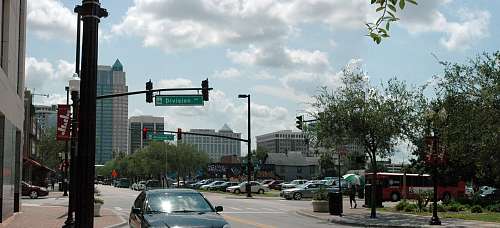
Ronbo's Tour of Downtown Orlando, Florida USA


Welcome To Orlando, Florida USA


The New Orange County Courthouse In Downtown Orlando


Ronbo's Favorite Irish Pub In Downtown Orlando That Has Closed


Central Blvd. and Orange Ave. In Downtown Orlando


Would You Believe Orlando Has A Wall Street?


A Florida Cracker And His Aligator


The Old Orange County Courthouse Now Belongs To History


The Side View Of The Old Orange Courthouse And History Center


The New Law College In Downtown Orlando


Main Entrance To The Old Federal Building


New Federal Building Under Construction In Downtown Orlando


New Construction On Orange Ave. In Downtown Orlando


Road Closed Due To Construction In Downtown Orlando


Orlando City Hall


Orange County Public Library In Downtown Orlando


The Confederate War Memorial In Lake Eola Park in Downtown Orlando


The Confederate soldiers, sailors and statesmen honored by their Countrymen

Friday, June 01, 2007

Mirabilis Staffing Firms Sell Off Assets

Mirabilis staffing firms sell off assets

---Pennsylvania-based ClearPoint Business Resources has agreed to acquire the contracts.
---Jim Leusner
---Sentinel Staff Writer

---April 4, 2007

---A Pennsylvania staffing company has agreed to buy the customer contracts from three professional employer organizations affiliated with Orlando-based Mirabilis Ventures Inc.

---ClearPoint Business Resources Inc. of Chalfont, Pa., signed a letter of intent on March 29 to buy assets for an undisclosed amount from The Human Resource Enterprise Corp., a Mirabilis entity.

---According to a ClearPoint news release, the assets to be acquired will be transferred from National Med-Staff Inc.; AEM Inc., which does business as MirabilisHR; and Paradyme Inc. All three of those staffing companies have had ties to Mirabilis Ventures, Mirabilis-related companies or entities involving Mirabilis founder Frank L. Amodeo of Orlando.
---The ClearPoint deal, contingent on a 45-day due-diligence period, came just as workers-compensation insurance for Mirabilis' companies was due to expire last Monday. ClearPoint's news release and a March 30 notice sent to MirabilisHR clients said the insurance has been extended through Aug. 1.

---ClearPoint and the Mirabilis companies are also known as "professional employer organizations," or PEOs. They handle payroll, employee benefits and workers-compensation claims for client companies that want to outsource such human-resources functions.

---The ClearPoint news release said the final deal will involve a swap of ClearPoint common stock and "minimum cash," though it could include deferred cash payments depending on how the purchased businesses perform.

---ClearPoint President Chris Ferguson would not comment on the deal Monday, citing U.S. Securities and Exchange Commission rules on pending acquisitions. The company trades on the Nasdaq Capital Market, formerly known as the SmallCap market.

---Dan Cence, a Boston-based Mirabilis Ventures spokesman, said MirabilisHR was "excited" about the "partnership" with ClearPoint, which will "allow us to maintain and increase the support all of our trusted clients have come to know and rely upon." He would not disclose the number of customers involved in the transaction, but a ClearPoint news release from March 23 said AEM alone had more than 2,000.

---Cence said Mirabilis, a private-equity fund, was involved in the sale as a normal course of business in its venture-capital operations.

---The Sentinel disclosed on March 3 that a federal grand jury in Orlando was investigating Mirabilis Ventures and has subpoenaed records of several related PEOs, including AEM, MirabilisHR and Paradyme, back to 2004. The company also had layoffs at the end of last year and has been reorganizing and consolidating in the months since then.

---Cence and a lawyer for Amodeo confirmed the federal probe last month and said they had cooperated with requests for records from prosecutors.

---Former managers at Presidion Solutions -- another PEO with ties to Mirabilis Ventures, Amodeo or his related companies -- have said that Internal Revenue Service investigators questioned them about accounting and employee-tax collections, including more than $100 million in missing payroll taxes collected from client businesses nationwide.

---ClearPoint, formerly known as Mercer Staffing Inc., says it was founded in 2001. It says it has 140 employees and about 3,500 contract employees at its client companies.

---ClearPoint said in late February that it has acquired substantially all of the assets of a Maitland company, ALS LLC, and its subsidiaries, doing business as Advantage Services Group. It said the purchase of that company, a provider of customized labor software, set the stage for a push into the Florida market.

---Jim Leusner can be reached at 407-420-5411 or [email]jleusner@orlandosentinel.com[/email].

Lawsuits: Mirabilis Failed To Pay Up

SENTINEL EXCLUSIVE

---Lawsuits: Mirabilis failed to pay up
---The business is accused of owing millions for loans or investments.
---Jerry W. Jackson and Jim Leusner
---Sentinel Staff Writers

---March 27, 2007

---Mirabilis Ventures Inc., the high-profile Orlando business under a grand-jury investigation, has defaulted on millions of dollars in promised payments for loans or investments, according to lawsuits filed recently in Alabama and Florida.

---The private-equity company, which has been retrenching in recent months, failed to pay more than $2 million by Feb. 1 for The Hancock Group LLC, a professional employer organization in Gadsden, Ala., according to a suit filed by four businessmen in U.S. District Court in Birmingham on March 8.

---A week later, a Seminole County businessman, Mark A. Lang, sued Mirabilis in state Circuit Court in Orlando, contending that the private-equity company defaulted on a $1.25 million promissory note.

---Dan Cence, a spokesman for Mirabilis, said last week he could not comment on any litigation. He also declined to identify any current officers or directors of the company, which during the past year has boasted that it owned or had a stake in as many as 70 businesses and employed hundreds of people in downtown Orlando.

---Mirabilis, which once talked of building a global business network, had begun raising its local profile last year through Orlando Magic sponsorships, big ads and pledges to charity. The company has said it often buys distressed companies and inherits problems that it then tries to resolve.

---Frank L. Amodeo, a local private-equity investor, is a defendant alongside Mirabilis in the Alabama suit, which contends that Amodeo and Mirabilis, after persuading Hancock's owners to sell the company and some related operations in February 2006, damaged the business through "gross mismanagement and a raiding of the company coffers."

---Amodeo owns AQMI Strategy Corp. of Orlando and was a key early investor in, and a consultant to, Mirabilis.

---The lawsuit alleges that, during the past year, "over the protests of the plaintiffs, THG [The Hancock Group] accounts payable have been shifted from the local office in Gadsden, Ala., to the corporate office of Mirabilis in Orlando, Florida.

---"Despite the fact that over a million dollars have been transferred from the operating accounts of THG in recent months, amounts of which are more than sufficient to meet the operating needs of THG, those accounts payable have fallen into disarray."

---The suit also alleges that utilities at the company offices were turned off on multiple occasions, vendors and employer taxes were not being paid, and the business apparently had been "sold to another parent corporation without any prior notice or consent of the plaintiffs."

---A professional employer association, or PEO, handles payroll, employee benefits and workers' compensation for other companies.

---While Amodeo's name is not on the Feb. 21, 2006, purchase agreement or any other documents included with The Hancock Group lawsuit, Phillip Williams Jr., the lawyer representing the four Alabama businessmen, said this week that he deems Amodeo's role so central to the deal and subsequent operations that he considers him the de facto "owner and operator" of Mirabilis.

---"In my opinion, he leads, guides and directs Mirabilis," Williams said, and as a result Amodeo was named individually as party to the suit. He said that, if the assertion is wrong, "they can prove it in court."

---A Mirabilis spokesman said late last year that Amodeo's stake in the private-equity company had been bought out and that he never had been an officer or director. But he continued to serve the company as a consultant, the spokesman said.

---The local breach-of-contract suit filed by Lang, the Seminole County businessman, alleges that Mirabilis defaulted on a $1.25 million promissory note Feb. 23.

---Lang, of Longwood, referred questions about the March 16 suit to his lawyer, Mitchell B. Grodman, but Grodman declined to comment other than to say the balloon payment was a "business debt."

---Mirabilis and other companies with ties to Amodeo are also battling lawsuits on other fronts.

---In Tampa, Mirabilis is a defendant in a recent case brought by investors in the proposed Trump Tower condo project, seeking repayment of deposits and contending that the project is too far behind schedule to meet deadlines.

---And in Nebraska, five owners of a group of PEO companies filed suit last month against a Nevada company that they say defaulted on a $4.5 million deal to buy the businesses.

---The owners of Alliance Compensation and Benefits Group and three related entities sued Wellington Capital Group in federal court in Omaha for breach of contract. The suit alleges that Wellington paid only half the money from the July 2006 deal and defaulted on promissory notes to individual owners.

---Court documents and the plaintiffs' lawyer, John Passarelli, identify Frank L. Amodeo of Orlando as the "authorized agent." Florida corporation records also list Amodeo as an officer in Wellington Capital Group, chartered in Nevada in 2003.

---"He acted as an agent for Wellington," Passarelli said of Amodeo. "He signed documents on behalf of Wellington."

---Amodeo's and AQMI's low profiles in Orlando were raised suddenly last May when two AQMI employees were detained, but later released without charges, while on a security assignment in the Congo.

---Mirabilis later sought to boost its corporate image with a public-relations push that included an agreement to be the Orlando Magic's "presenting sponsor" for the 2006-07 NBA season.

---Earlier this month, the Sentinel reported that a federal grand jury in Orlando was investigating Mirabilis and some related human-resource and payroll-processing companies.

---A grand-jury subpoena obtained by the Sentinel showed that federal prosecutors had sought records from clients who had contracted since 2004 with payroll companies affiliated with Mirabilis and its various entities.

---Harrison "Butch" Slaughter, Amodeo's lawyer, said he would not comment on any litigation or investigation. He said earlier this month that he has turned over hundreds of thousands of corporate documents subpoenaed by prosecutors.

---On Saturday, an unidentified Mirabilis Ventures employee and several workers removed computers and several boxes of records from an office at 5750 Major Blvd. in Orlando. They declined to comment to a reporter.

---Mirabilis and its entities have continued reorganizing and consolidating in recent weeks. In late February, Mirabilis employees left company quarters in the AmSouth tower on Orange Avenue in Orlando. A former company spokesman said at the time that the workers had moved down the street to offices in SunTrust Center as part of a planned consolidation.

---The company has acknowledged laying off several dozen workers at the beginning of the year, and according to Cence has been selling or closing underperforming firms while nurturing the profitable ones.

---Efforts to reach any local legal representatives of Mirabilis in recent days have been unsuccessful.

---A Fort Lauderdale law firm that represented Mirabilis in a breach-of-contract suit against another company last summer in state Circuit Court in Orlando filed a motion to withdraw from the case Feb. 27. "I have no idea what's going on with the company," said Richard Berman, a partner in the firm of Berman, Kean & Riguera.

---Lawrence Haber, an Orlando-area entertainment lawyer who also has been associated with the company in the past, said last week that he no longer does any work for Mirabilis but could not comment further.

---Jerry W. Jackson can be reached at [email]jwjackson@orlandosentinel.com[/email] or 407-420-5721. Jim Leusner can be reached at [email]jleusner@orlandosentinel.com[/email] or 407-420-

Condo Reality Trumps Trump's Sales Bluster (Mirabilis)

Condo reality trumps Trump's sales bluster
Published March 18, 2007

Are you thinking about buying an upscale, urban condo?

Don't settle for some chump dump in downtown Orlando. Not when you can move down the road to Tampa and live like The Donald.

Ladies and gentlemen, I give you Trump Tower Tampa, 190 units and 52 stories of sheer elegance.

Here it is, straight from Donald's mouth: "The architectural design is truly distinctive, establishing a bold new landmark on the city skyline. Every residence will afford sweeping views of the water, and every detail -- from the splendid finishes to the unrivaled amenities -- will reflect the exceptionally high standards that every Trump building must satisfy."

Donald arrived at the sales launch in 2005 with his usual panache. He proclaimed the project a major success with reservations on 98 percent of the units. He bemoaned not owning any more of the project than his already "substantial stake."

Downtown Tampa was to be reborn. The groundbreaking was in March 2006, with completion in 2008.

And now I fast forward to the present, standing at a spot where I should be buried under a good 30 stories or so of rising concrete and steel.

Weeds are the only visible life form. One crane stands idle. The snout of a second one rests limply on the ground, like it is taking a siesta.

Piles of rusting steel are scattered about, along with empty cable spools. The banners proclaiming: "A development of Donald J. Trump and SimDag" are weathered and turning dark from soot. One has partially broken free and is drooping from a fence.

It would appear that The Donald is in The Dumps. Too bad Rosie O'Donnell isn't here to see this.

Even the Trump name can't trump the great Florida condo implosion. The project has been plagued by vanishing buyers and lenders, cost overruns and a string of contractors and developers. It is saddled with about $3 million in construction liens.

In his usual blustery style, Trump told the Tampa Tribune last year he was prepared to buy out the project, which he could build "out of my back pocket." Never happened.

Instead, a private-equity group in Orlando called Mirabilis Ventures Inc. bought controlling interest. Ever since it has been closing offices and now is being investigated by a federal grand jury.

The project is so muddled that attorney Tom Long, who is suing to get a deposit back for two buyers in the building, says, "Frankly, I don't know who owns it."

It turns out Trump's "substantial stake" was a licensing fee for use of his name. If the project is a success, he makes a bundle. If not, then it's no big hit on his bank account.

No wonder he is married to Melania Knauss.

Buyers who put down 20 percent, many of them investors, are in a sticky situation. If they all demand their money back now, that could increase the odds of a bankruptcy.

As with many high-flying Florida condos, once you shake out speculators and flippers, it's hard to find locals who can afford to live in them.

But where there is the Trump name, hope springs eternal. At the lonely sales office, real estate agent Toni Everett still has her red laser pen ready to point out amenities on a model of the building.

Desperate for good press, she offers me first crack at any big news about the project for a positive article.

Well, the outdoor pool on the 10th floor looks killer. And you still can get a two-bed, 2.5-bath, with private elevator access, for only a million bucks.

Toni says people will be moving into Trump Tower Tampa in 2009.

If she's right, I'll take a swan dive into the neighboring Hillsborough River from the 52nd floor.

Mike Thomas can be reached at 407-420-5525 or [email]mthomas@orlandosentinel.com[/email].

Resort Tax Feels The Magic Of Disney's Hotels (Mirabilis)

Resort tax feels the magic of Disney's hotels

Posted March 8, 2007

Occupancy levels at Walt Disney World hotels are a well-guarded secret. But Disney recently gave a glimpse into the big role it plays in Central Florida's lodging industry with a revealing statistic: Last year, it contributed 33 percent of all resort-tax dollars collected in Orange County, and 22 percent of Osceola County's collections. Disney has more than 24,000 hotel rooms in 22 company-owned resorts. There are another 111,000 hotel rooms in the Orlando area, according the Smith Travel Research.

A slight delay

The Burnham Institute, eager to set up its Central Florida operation after receiving final approval this week for Orlando and Orange County tax incentives, won't be starting quite as soon as expected. Burnham had expected to open in remodeled space at Florida's Blood Centers in south Orlando in June. But remodeling hasn't begun and it won't be completed until late July. The research institute plans to reside at the Blood Centers while it builds permanent quarters near Lake Nona.

Replacement parts

Lockheed Martin Corp.'s Orlando missiles unit snagged another huge military contract this week -- $311 million to produce navigation and weapons-firing systems for Army helicopters. A large chunk of that is for replacement parts used in the Iraq war. Defense experts say that the U.S. will have to spend billions more to replace military gear damaged or worn out during the four years of fighting. That means more big contracts for defense contractors -- and a growing price tag for taxpayers.

Gifts for Ruth's Chris

Fast-growing Ruth's Chris Steak House has received a hefty gift from its gift-card customers. The Lake Mary-based company said in its most recent earnings report that it booked nearly $4 million in income from "gift card breakage" -- corporate-speak for cards sold but never used. Ruth's predicts millions of dollars of company gift cards won't be redeemed, and based on that expectation, it is declaring the money collected for the cards as income. Companies typically don't declare gift-card proceeds as income until they are used.

Tower investors want out

Two investors who agreed to buy a condo unit in Trump Tower Tampa are suing to get their money back, claiming the riverfront project is not likely to be built by the December 2008 contract deadline. Mirabilis Ventures Inc., an Orlando-based private-equity company, is a defendant -- even though the Tampa lawyer representing the investors said he's not sure the outfit has closed on its acquisition, announced in November, of the proposed 52-story tower. "I can't confirm it until I get some depositions," said Thomas G. Long, representing two Walton County investors. Mirabilis spokesman Dan Cence said the Trump Tower project is "on the record and moving forward as planned." A motion to dismiss is pending. Mirabilis recently laid off a number of employees and closed some of its Orlando offices in an apparent consolidation, though the company has refused to elaborate.

Code name 'Daytona'

Word on the Web is that a new BlackBerry with the code name "Daytona" is in the works. Tech companies are infamous for giving nicknames to projects under development. For example, Intel has used a variety of rivers in the West as code names for computer chips in development. Microsoft once referred to an upcoming version of Windows as "Longhorn." The new BlackBerry has not been confirmed yet by Research in Motion, the Canadian company that created the widely used e-mail devices.

Christopher Boyd compiled this report with contributions from Chris Cobbs, Harry Wessel, Jerry W. Jackson, Richard Burnett and Mark Chediak. He can be reached at 407-420-5723 or [email]cboyd@orlandosentinel.com[/email].

Grand Jury Investigates Mirabilis

SENTINEL EXCLUSIVE

Grand jury investigates Mirabilis
A federal probe targets the Orlando private-equity group's tax collections, sources say.
Jim Leusner
Sentinel Staff Writer

March 3, 2007

Mirabilis Ventures Inc., a private-equity group based in Orlando, is under investigation by a federal grand jury, authorities confirmed Friday.

The once-obscure company was forging grandiose plans to build a global empire. But now it is the subject of a wide-ranging probe focusing on millions of dollars in employment taxes collected from businesses but not turned over to the government, several sources said.

Former company officials said they have been interviewed in recent months by the Internal Revenue Service about the finances of Mirabilis and several payroll and human-resource-company subsidiaries that have operated under the investment fund's umbrella.

A spokesman for the U.S. Attorney's Office in Tampa, after being told the Orlando Sentinel had interviewed government witnesses and had obtained a grand-jury subpoena for records, acknowledged there was a probe of Mirabilis and its units. One unit, Presidion Solutions, is among the firms hired by businesses to handle their human-resource and payroll needs, including the collection of taxes such as Social Security.

"There are no charges that have been filed, but we are conducting an investigation into a number of entities under one umbrella," spokesman Steve Cole said. He would not elaborate.

News of the probe surfaced after the company laid off workers amid a reorganization, according to former employees. The Mirabilis Web site says it is being modified "to reflect our reorganized business model."

'A shell of its former self'

One former Orlando employee, who was an executive of the company but did not want to be quoted by name, said this week that he had not been paid since January and that he does not know who is running Mirabilis.

"It's a shell of its former self," he said, adding he heard 120 employees recently were cut. A company spokesman said in January that there were about 400 employees in Orlando.

Dan Cence, a Boston-based public-relations specialist acting as Mirabilis' spokesman, acknowledged Friday that there is an investigation into Presidion Solutions that is "being dealt with by Mirabilis and other related companies. They are fully complying with all requests for documentation and information."

"This is a company that acquires distressed companies," Cence said. "It takes all of the warts that come with distressed companies. You attempt to root out what's wrong and bad with companies, then identify and foster and grow the good companies."

Mirabilis, he said, is healthy, fully funded, holds no debt and is at the stage where it is selling or closing underperforming firms and nurturing the profitable ones. He would not comment further on Mirabilis, which had more than 70 companies and revenues nearing $1 billion, officials said last summer.

Mirabilis was a shell company in 2005 when Orlando investor Frank L. Amodeo provided financial backing to build it. He specialized in acquiring distressed firms such as Presidion Corp. and Presidion Solutions and bringing them under the Mirabilis umbrella.

Through a receptionist at his SunTrust tower offices Friday, Amodeo declined to talk to a Sentinel reporter. He remains a consultant to Mirabilis but is not an officer or employee of the company.

In an interview with the Sentinel in June, Amodeo said he helped arrange Mirabilis' purchase of $25 million in Presidion Corp. preferred stock with 32,500 pounds of "precious-metal concentrate" -- gold- and platinum-mining residue. He said he helped provide seed money to form the fund and served as its chief strategist through his privately owned AQMI Strategy Corp. consulting company.

Amodeo said he was building a global empire with businesses ranging from worldwide economic forecasting to fraud and money-laundering detection, while also engaging in philanthropic ventures. He said he had reformed since being disbarred as a bankruptcy lawyer in the Atlanta area in 1994. He was sentenced to two years in prison in 1998 for defrauding a client.

Amodeo later moved to Orlando and began buying or investing in distressed companies, raising his profile about a year ago, mingling with Orlando Mayor Buddy Dyer at charitable events, donating $25,000 to CrimeLine and being on the organizing committee for a fundraiser for U.S. Sen. Bill Nelson. Mirabilis also has funded charitable events and become a major sponsor of the Orlando Magic.

More than 100 subpoenas

Harrison "Butch" Slaughter, Amodeo's lawyer, said Friday that he has turned over hundreds of thousands of corporate documents subpoenaed by federal prosecutors. He said he also is turning over an additional 32 pallets of records.

Slaughter, however, would not elaborate because of the ongoing probe.

Former Presidion managers said they and others have been questioned by IRS investigators about Mirabilis and Presidion's financial relationships. Questions centered on Presidion's collection of payroll taxes on behalf of other companies. Two former company officials said more than $100 million in payroll taxes collected from thousands of employees at client businesses nationwide was not turned over to the government.

They also said IRS investigators have questioned former Presidion managers and workers to determine who wrote an anonymous letter, apparently by a corporate insider, to the agency in April alleging employment-tax fraud.

A grand-jury subpoena, issued to a Volusia County business and obtained by the Sentinel, requests that the company turn over all records since January 2004 involving "employee and payroll services" provided by Mirabilis and eight of its units, including Mirabilis HR, Presidion Corp. and Presidion Solutions. It is signed by Assistant U.S. Attorney Randy Gold, the No. 2 man in the agency's Orlando office, and is one of more than 100 subpoenas in the case.

The business owner, who insisted on anonymity, confirmed that Mirabilis and Presidion entities serviced her company. She confirmed the probe but said she did not fully understand it.

Jerry W. Jackson of the Sentinel staff contributed to this report. Jim Leusner can be reached at 407-420-5411 or [email]jleusner@orlandosentinel.com[/email].

Mirabilis Equity Firm Faltering

SENTINEL EXCLUSIVE

Mirabilis equity firm faltering
The Orlando company with global dreams has closed offices and cut staff.
Jerry W. Jackson
Sentinel Staff Writer

March 2, 2007

Mirabilis Ventures Inc., a private-equity company in Orlando that once boasted it would build a global network of businesses, has closed some offices, muzzled its longtime spokesman, and removed the names of officers, directors and managers from its Web site in recent days.

The company, which has raised its local profile in recent months through Orlando Magic sponsorships, big ads and pledges to charity, also lost its vice president of philanthropy Thursday. Former television-news anchor Andrea Coudriet said she was stepping down immediately of her own accord to devote more time to her year-old public-relations business.

"A lot of things are being reorganized," said Horton "Woody" Johnson, a Mirabilis executive and investor who has been the face and voice of the company since its early days in 2005. But he said he was told he could no longer speak for Mirabilis.

Mirabilis was a relatively obscure Orlando business until a separate security company owned by one of its key investors, Frank L. Amodeo, made headlines when two security employees were detained in Africa last summer. The two AQMI Strategy Corp. workers, said to be on assignment advising a presidential candidate in the Democratic Republic of the Congo, were released by the government after nine days and returned home to Orlando.

Amodeo, a venture capitalist and former bankruptcy lawyer who was disbarred in Georgia, provided Mirabilis with seed money and got it up and running about three years ago.

1 hour away or less

After the Congo incident, Mirabilis and Amodeo began a public-relations campaign to boost the company's image. The company, which talked of having interests in dozens of companies employing thousands of workers, signed marketing deals with the Orlando Magic and other sports teams, pledging charitable donations and buying newspaper ads to burnish its brand.

With Mirabilis looking to make investments in everything from restaurants to staffing companies, Amodeo pitched the company in meetings with business people in Orlando as a fast-growing outfit that would quickly expand worldwide. He boasted to the Orlando Sentinel that by 2012 the company would have as many as 500,000 employees and "offices within one hour of every human alive everywhere."

But now the company's expansion has come to a screeching halt.

Johnson acknowledged earlier this week that Mirabilis employees have left the company's offices in the AmSouth tower on Orange Avenue. He said they moved down the street to quarters in SunTrust Center as part of a planned consolidation, while he has moved to the Maitland office of his i-3 Media Group, a marketing and public-relations business that has been listed by Mirabilis as one of its "operating subsidiaries."

Johnson said he could no longer talk about who is in charge of Mirabilis these days and was told to refer all questions about the privately held company to an outside consultant who flew into town this week.

Dan Cence, a public-relations specialist who has done work in the past for companies related to Mirabilis, said he arrived Tuesday and met with executives Wednesday for a briefing. But he said afterward he could not make any public comment for now and did not know when he would be able to speak. He would not identify the executives at the briefing, name any executives who are running the company, or provide any other details.

32 layoffs?

In early January, Johnson -- speaking for Mirabilis at the time -- said the company had laid off 32 employees and had not called back 10 temporary workers after the Thanksgiving-to-Christmas holidays. He said the company -- which at the time listed Fernando Simo as its chief executive officer -- still had about 400 people directly employed in three downtown Orlando offices, making the layoffs "relatively small."

But Angela Hackett, who did business-development work for the company until she was laid off Jan. 2, said she and other employees thought the layoffs had been closer to 150 people -- and that many more may have since been shown the door.

"For the amount they spent on philanthropy, it just didn't seem right," Hackett said of the job cuts.

Less than two months before the January layoffs, the Orlando Magic had announced that Mirabilis Ventures was to be the NBA team's "presenting sponsor" for the 2006-07 season, in a "two-year partnership with a three-year renewable option."

The Magic at the time said the partnership included "an annual $100,000 donation to the Orlando Magic Youth Foundation, which will be distributed to the Central Florida community on behalf of Mirabilis."

Orlando Magic spokesman Joel Glass said this week that the only comment he could make about Mirabilis is "they have honored their marketing contract with us, up to this point."

Coudriet said Mirabilis' charitable work has included a $50,000 donation to Shepherd's Hope, which provides medical services for the poor, and $45,000 to the Hispanic Chamber of Commerce.

Mirabilis is privately held and not required to publicly report revenues, profits or losses, or material events that might affect its operations. But in recent years, a number of company employees or representatives -- including George Stuart Jr., a former state senator and gubernatorial candidate from Orlando -- talked of how the company had acquired or invested in as many as 70 companies with combined revenue approaching $1 billion.

Leaving the building

Stuart was listed as a managing vice president in Orlando for Mirabilis on its Web site last year and early this year, before the names of executives were removed, and he worked out of the AmSouth offices.

But a person staffing the foyer to those former Mirabilis offices this week said Stuart and most other employees had left the building, and she could not say where he was located. She referred questions to Johnson in "our Maitland office," but Johnson said he could not comment on Stuart's whereabouts or status with the company. Efforts to reach Stuart at his home or office were unsuccessful.

While Amodeo's ties to Mirabilis were widely known by mid-2006, the company later said it had severed its ownership relationship with Amodeo by buying back his private stake for $1 million. The company also took steps to note that he was never an executive or officer of the business, in part, because of his "checkered past." Yet the company continued to acknowledge his relationship as a "consultant" and "rainmaker" who brought potential acquisitions to the table.

At least one executive in charge of a company acquired recently by a Mirabilis affiliate reported having trouble this week locating Mirabilis officials in Orlando. And some telephone calls, he noted, were forwarded to Amodeo's AQMI Strategy Corp.

"If they all left, who is running the show?" said Craig Morningstar, a Scottsdale, Ariz., businessman who said he sold his Synergy Franchise Services consulting company to BrandChise Global Inc. of Orlando for an undisclosed amount.

Jim Leusner of the Sentinel staff contributed to this report. Jerry W. Jackson can be reached at [email]jwjackson@orlandosentinel.com[/email] or 407-420-5721.

Congo Drama Unveils Enigma (Mirabilis)

---Congo drama unveils enigma

---Jim Leusner

---The Orlando Sentinel

---July 02, 2006

---The incident happened on the other side of the world, but it cast a spotlight on a low-profile businessman and the crisis-management firm he operates in the heart of downtown Orlando.

---Two local employees advising a presidential candidate in the Democratic Republic of the Congo had been arrested and detained, and Frank L. Amodeo was making pleas for help to government, humanitarian and media organizations. When Joe Robinson of Orlando and Kevin Billings of Maitland were released nine days later from the central African country, they flew the final leg of their trip on Amodeo's Learjet. He was the first to welcome them home.

---Until that highly publicized event last month, Amodeo had been operating unnoticed by most people in Central Florida. Yet in the past several years, he and his associates have assembled a network of interconnected businesses that spreads across three floors of Orlando high-rises.

---Amodeo, a venture capitalist, says he was the major financial backer in the purchase of Mirabilis Ventures as a tiny company in 2005. Since then, Mirabilis has bought or has purchased a partial interest in 70 companies that Amodeo says have combined annual revenues of about $1 billion. One of those affiliated companies is AQMI Strategy Corp., which employed the two men in Congo and lists Amodeo as its president.

---The companies under the Mirabilis umbrella range from security operations to consulting firms to construction businesses, and Amodeo says they employ 1,500 full-time and 3,500 temporary workers.

---Because Mirabilis is privately held, there is no way to independently confirm many of Amodeo's statements.

---'By 2012, I expect I'll have offices within one hour of every human alive everywhere,' he said during a recent interview with the Orlando Sentinel. 'At that time, we'll probably have 30,000 [employee] consultants and 500,000 [other] employees.'

---Mirabilis, he has told employees, will 'change the world.'

---Disbarred, imprisoned Amodeo, 45, has gone through his own transformations. He was disbarred as a bankruptcy attorney in Georgia for his handling of a client's funds and spent two years in federal prison after pleading guilty to defrauding another client out of $50,000.

---Born in Detroit and raised in Orlando, Amodeo graduated from the University of Central Florida before moving to Atlanta to attend the Emory University School of Law. He started his law practice in Georgia in 1988.
He was disbarred six years later after that state's Supreme Court found he repeatedly mishandled a client's funds. The court found that Amodeo failed to return money to the client and wrote several checks on closed accounts. In its ruling, the court also said Amodeo engaged in unprofessional conduct involving 'dishonesty, fraud.'

---The client in that case, Alphe Pearl of Atlanta, said she turned to Amodeo to manage debts in December 1991 after a partner in a collection agency stole money and died. Instead, she said, Amodeo never repaid the money she gave him.

---Amodeo said he paid Pearl $30,000 before he left Georgia, but she said she is owed thousands more.

---'I'm a senior citizen and could use that money,' said Pearl, 72.

---Amodeo acknowledges that a dozen clients in Georgia have sued him, claiming he owes them several hundred thousand dollars. He said the actual losses were about $150,000 and largely the result of failed investments with clients, not fraud. Amodeo said he paid back some victims and is in the process of repaying the others.

---'I had some great cases,' he said. 'And I was absolutely horrendous at managing the firm.'

---Turning his life around After his disbarment, Amodeo returned to Orlando. He worked in real estate and also served as a 'liquidation agent,' helping troubled businesses to shut down, records show. But troubles soon followed.
In 1995, he was arrested and jailed in Orange County on forgery and grand-theft charges leveled by a business associate. Prosecutors later dropped the charges. In 1996, the Internal Revenue Service slapped Amodeo with $83,000 in tax liens. In 1997, he filed for bankruptcy with only $500 to his name. A year later, he was sentenced to federal prison plus three years of probation in Georgia based on the $50,000 fraud case that occurred in 1993.

---It was in prison, Amodeo said, that he came to grips with his mistakes.
'I wasted my [law] license,' said Amodeo, who is married, has two children and lives in Orlando. 'I was wasting my talents. . . . It was stupid.'
Prison, he said, 'was sort of God's way of waking me up. . . . While I was at [prison] boot camp, I became something different.'

---By late 2003, court records show, Amodeo paid the $50,000 restitution in the Atlanta criminal case, was off federal probation and was making money buying or helping business clients close troubled companies. During the next few years, Amodeo said, he started commanding fees up to $100,000 and began to repay the IRS, creditors, friends and former clients in Atlanta.
In one deal to turn around a company, Amodeo said he made enough money to be the main financial backer in the purchase of then-tiny Mirabilis and to begin hiring experts to run it. Citing client confidentiality, he would not provide details of the deal.

---'He was always smart,' said his father, Frank P. Amodeo, 67, who lives in Orlando. 'He's almost at the genius level.'

---The elder Amodeo made headlines several years ago as a lead plaintiff in a class-action lawsuit against five major tobacco companies. A Florida jury awarded a record $145 billion judgment to sick Florida smokers in 2000. The case, including Amodeo's $5.8 million award, was thrown out by a state appeals court. It is still tied up in Florida's Supreme Court.

---Thinking big Sitting in his 28th-floor office of AQMI Strategy Corp. at the SunTrust Tower in Orlando, Amodeo explained his current role in Mirabilis, the holding company with which AQMI is affiliated.

---Amodeo said he is an adviser to Mirabilis and its holdings but not a day-to-day manager. But he says he finances acquisitions, brings in new businesses to the firm and helps close big deals.

---'It's all my money,' he said.

---Amodeo said Mirabilis and its subsidiaries evaluate distressed restaurant, construction, human-resources, insurance and real-estate companies -- or any other firm that fits into his 'capital genesis' philosophy. The theory focuses on buying companies cheap, turning them around and using Mirabilis-related affiliates as their vendors, keeping profits within the conglomerate.
Amodeo acknowledges his approach can be unconventional and involve creative funding.

---For example, in a 2005 buyout of Presidion Corp., a payroll and human-resources company, Amodeo said Mirabilis used 32,500 pounds of 'precious-metal concentrate' -- gold- and platinum-mining residue -- to buy $25 million in preferred stock.

---Behind his desk are seven types of globes mapping out the world. On the wall is a plasma monitor with Synex, interactive software Mirabilis is developing for a mapping, economic and world-behavior model to follow and predict global business trends.

---Mirabilis also is involved in charity work, according to the Web site of its key consulting subsidiary, Nexia Strategy Corp.

---The site includes press releases about Mirabilis' charity to Hurricane Katrina victims, needy Orlando kids and Crimeline, as well as photos of Amodeo donating or raising money.

---'Frank is a genuine humanist,' said Robert Pollack, a physician and top Mirabilis officer. 'Frank truly makes and believes in making life better for the world around him.'

---Raising his profile Amodeo has generally kept a low profile.

---But during the past year -- and in the midst of the political season -- Amodeo has started to raise his public image. Earlier this year, he and his top executives were photographed with Orlando Mayor Buddy Dyer after contributing $50,000 for a children's charity event that Mirabilis helped sponsor.

---Recently, Amodeo's office hosted a book-signing and congressional fundraiser for Democrat Charlie Stuart. The man signing the books: Richard Clarke, who has been an adviser to the administrations of President Bush and his father, as well as those of Bill Clinton and Ronald Reagan. In another recent event, Amodeo was listed on the host committee for a fundraiser for Democratic U.S. Sen. Bill Nelson.

---Stuart's brother, George, a former Orlando city commissioner and ex-state senator, joined Mirabilis and Nexia last year. He compares Amodeo to Orlando business and community-minded pioneers such as lawyer-banker Billy Dial and ABC Liquors founder Jack Holloway, who are deceased, and retired Darden Restaurants CEO Joe Lee.

---New legal challenges Last month, the U.S. trustee in a Tampa bankruptcy case alleged in court documents that Mirabilis or its employees 'engaged in fraud, dishonesty and mismanagement, and/or are incompetent' to manage the affairs of Community Health Solutions of America LLC. Mirabilis invested in the company last year, and Community filed for bankruptcy earlier this year.
The trustee charged that Mirabilis billed the company $96,000 in excessive fees and withdrew $480,000 from accounts in the days and weeks before it sought court protection and omitted withdrawals from bankruptcy statements.

---Amodeo said Mirabilis invested $1.9 million in Community and pushed for the initial bankruptcy so the court could oversee its activities. He said his lawyers will prove Mirabilis did nothing wrong.

---'I'm telling you that not only is it not true, it's not possible,' he said.
Amodeo has filed an objection to the new trustee appointed to the case -- Tampa attorney John Anthony -- who he charged in court records was biased and defamatory in past litigation. A Tampa bankruptcy judge, however, ruled recently that Anthony had no conflict in the Community Health bankruptcy matter and could remain on the case.

---In 2004, Anthony had complained in a letter to the U.S. Secret Service that Amodeo and some associates had siphoned cash in the bankruptcies of a Daytona Beach company -- Atlas Welding -- and another unrelated business in Fort Lauderdale.

---Anthony at the time represented Merrill Lynch Business Financial Services, a creditor of the two failed companies.

---Amodeo denied the accusations in court records, and Merrill Lynch dropped a lawsuit against him in the Fort Lauderdale case. A bankruptcy judge also ruled that Merrill's claims of financial irregularities by Amodeo were 'largely unfounded' and that allegations of 'hidden assets . . . simply did not exist.'

---'If anyone loses money in bankruptcy cases, it's me,' Amodeo said.
Amodeo insists he is not squandering the hard lessons he has learned -- and is making the most of his life.

---'I will not miss opportunities for the things I need to do,' he said. 'But what I do need to do is that I use the second chance and make the world a better place.'

---Jim Leusner can be reached at [email]jleusner@orlandosentinel.com[/email] or 407-420-5411.

Harry Potter Comes To Orlando


The Wizarding World of Harry Potter is coming to Universal Orlando's Islands of Adventure, with construction to being this year with a planned 2009 opening.

Harry Potter theme park coming to Orlando's Universal Studios

Islands of Adventure theme park to feature The Wizarding World of Harry Potter

Scott Powers

Sentinel Staff Writer

May 31, 2007

Universal Orlando has secured rights to the phenomenally successful Harry Potter stories and will build a themed area of rides, shops and restaurants called "The Wizarding World of Harry Potter" at Islands of Adventure.

Universal, author J.K. Rowling and Warner Bros. Studios, which makes the Harry Potter movies, are making a worldwide announcement of the deal today. Universal expects to break ground late this summer and have "Wizarding World" open by late 2009.

In an interview with the Orlando Sentinel, Universal Orlando Resort President Bill Davis characterized the deal as perhaps the biggest in the resort's history, and one of the biggest in theme-park business history.

The announcement ends long-simmering, unconfirmed industry speculation that both Universal and Walt Disney Parks and Resorts have been bidding to acquire theme-park rights to the boy-wizard wonder. The brainchild of British author Rowling, the Harry Potter series of books and movies has grossed billions of dollars in sales over the past decade.

The news also redefines prospects for Universal Orlando. Universal has seen a slow, steady slide in attendance since 2004 -- including a drop of 2.8 percent to 2.1 million visitors in the first quarter of this year -- and has struggled to address criticism that it hasn't added much new excitement in recent years.

"We think this is the most exciting news we've ever had out here," Davis said. "We think it is going to have a huge impact on all our constituencies: our guests, our team members, our management team, everybody. This is absolutely huge. We're just thrilled and excited we were selected for the 'Wizarding World of Harry Potter.' "

No terms have been disclosed of the contract between Universal, Warner Bros. and Rowling. Universal declined to reveal what it intends to invest in "Wizarding World." But the corporation's annual report released earlier this year indicated the company intended to spend up to $120 million this year on new items -- triple what was spent in 2005 or 2006 -- and Davis said the company would have high capital budgets in 2008 and '09 as well. Universal also has announced a new ride based on The Simpsons cartoon, to open next year.

In a news release, Tom Williams, chairman of Universal Parks and Resorts, vowed that the company would "devote more time, more money, more expertise and more executive talent from throughout our entire organization and creative team -- as well as from Warner Bros., our partners -- to ensure that this entire environment is second-to-none."

In the same release, Rowling declared, "The plans I've seen look incredibly exciting, and I don't think fans of the books or films will be disappointed."

In her Harry Potter books, Rowling created a fictional, magical world of witches and wizards existing parallel to -- yet largely hidden from -- ordinary, contemporary Britain. The stories center on Harry, a young wizardry student, and his friends at a boarding school called Hogwarts. Together, they struggle with schoolwork, family problems, teen angst, young love, and evil wizards and witches trying to kill them.

A 20-acre Potter 'island'

Universal plans a 20-acre "Wizarding World," a little bigger than the average size of its themed "islands" at Islands of Adventure. Part would be carved away from what is now "The Lost Continent" island, and the rest would be land now used for employee parking and park support, outside the back fence.

The new, "seventh island" would feature reconstructed and rethemed attractions, and all-new ones, Scott Trowbridge, vice president of Universal's Creative Studios, said in an interview. The Hogwarts castle and locations from Rowling's Forbidden Forest and Hogsmeade village will be created as backdrops to attractions, shops and restaurants.

Three-time Academy Award-winning production designer Stuart Craig, who designed sets for all the Harry Potter movies, leads the "Wizarding World" design team.

Much of "The Lost Continent" island, including Universal's award-winning Mythos Restaurant, will be retained as a separate themed area, just smaller. The island is to remain open during construction as well.

Some current "Lost Continent" attractions such as The Dueling Dragons roller coasters and The Flying Unicorn coaster ride likely would be adapted to fit the Harry Potter story. Trowbridge would not discuss specific attractions, but did say that Universal intended to "leverage some existing infrastructure." He said that would have to include far more than a new paint job and a new sign, because too much is at stake.

Davis agreed, noting that the large, dedicated fan base that Universal hopes to capture could turn on the resort if fans conclude Universal cheapened the Harry Potter concept.

"We do have a responsibility to all the fans that are out there in the world that have followed the Harry Potter saga through the films and the books," Davis said. "We're taking that very, very seriously. We're going to be true to the books and the films, and make sure that when people come here they're going to be very, very happy with what they see."

Billion-dollar business

The Harry Potter phenomenon has been phenomenally lucrative.

The first six books have sold more than 300 million copies, in 63 languages, according to the BBC Web site. The most recent, Harry Potter and the Half-Blood Prince, sold nearly 7 million copies in the United States just in its first day in print.

The four movies have pulled in more than $3.5 billion so far, according to the independent Hollywood tracking Web site boxofficemojo.com. All of the movies are among the 20 highest-grossing ever, led by Harry Potter and the Sorcerer's Stone, which, with a $976.5 million box office, is the fourth-biggest film of all time.

And the Harry Potter story continues.

The seventh and final novel, Harry Potter and the Deathly Hallows, will be released July 21. The fifth movie, Harry Potter and the Order of the Phoenix, will be released July 11. The sixth and seventh films are certain to follow in coming years.

And now coming at the end of this decade: "Harry Potter and the Islands of Adventure."

If it had looked to some critics as if Universal had not brought much new to Islands of Adventure lately, it's because the company had been seeking "the right fit," then working to get Harry Potter when it became available, Trowbridge said.

"We've worked for the past couple of years to figure out how we could bring it to life," he said. "We were really looking for something that had the kind of power, the kind of transportive and immersive world of imagination that Harry Potter brings."

Monday, November 27, 2006

Downtown Makeover


SENTINEL SPECIAL REPORT: DOWNTOWN MAKEOVER

21st-century downtown

Orlando's plans for 3 venues aren't just about buildings. Urban designers want to use them to create a more vibrant commercial and residential city.

Mark Schlueb
Sentinel Staff Writer

November 27, 2006

The arts and sports venues proposed in Orlando would cover only a small part of downtown, but city officials hope they will be the catalyst for even more radical changes.


A team of urban planners hired by the city has recommended an ambitious slate of changes that -- if they happen -- would transform large stretches of downtown Orlando into pedestrian-friendly corridors with a vibrant mix of housing, restaurants, stores and offices.While such "master plan" exercises are not uncommon in growing cities, planners say Orlando's situation is unique. As city officials build a new performing-arts center and NBA arena and renovate the Florida Citrus Bowl, they will have a rare opportunity to change nearby land and streets and perhaps redo entire corridors, planners say.Urban designers recently presented their ideas to the City Council, which in the coming months could be asked to discuss specific recommendations.


"The potential is like no other city I know. This is the future you are creating," said Troy Russ of the planning firm Glatting Jackson Kercher Anglin.
Among planners' recommendations:


The TD Waterhouse Centre would be demolished, freeing up the site and the acres of parking lots around it for a "creative village" with the fledgling University of Central Florida digital-media school and other high-tech businesses. Planners would extend Terry Avenue, which now reaches a dead end at Robinson Street, a half-mile north to Colonial Drive.

Terry would become a landscaped "grand boulevard" with a wide, tree-lined median. Planners envision Terry flanked by mixed-use office, commercial and residential buildings serving a range of income levels. They also want to extend Terry at its southern end past Anderson Street and the East-West Expressway, and let it serve as a boundary between downtown's core and the residential areas to the west.

The stretch of West Church Street between Garland and Division avenues -- in front of the proposed Orlando Magic arena -- would be designed as a decorative "festival street," which would be closed to vehicle traffic during Magic games, concerts and other events. By removing cars from the street, planners say, fans would be encouraged to linger and patronize nearby shops and restaurants.

Tailgating at the Florida Citrus Bowl now mostly takes place south of the stadium, with the north side used for bus parking on Church Street. Planners would swap the two, encouraging pre-game activities in Lorna Doone Park. The park is now mostly used for parking on game days, but planners say it deserves a makeover.
A handful of new street connections would give commuters more ways to drive in and out of downtown's core and link it with development around Orlando Regional Medical Center to the south.The south end of Magnolia Avenue would be extended to connect with Orange Avenue just north of Lake Lucerne, steering some traffic around downtown's most congested areas. Similarly, Boone Avenue would be extended south to join up with Lucerne Terrace, providing a new link to the hospital area.Mayor Buddy Dyer, whose administration paid Glatting Jackson $400,000 to develop the plan to integrate each of the community venues into downtown, said the recommendations have the potential to bring great change."We can establish our downtown and our city as the greatest 21st-century city," Dyer said. "You only get one chance to do this right."
The recommendations would push downtown's functional boundaries farther west and south. But whether the recommendations go anywhere depends on a number of factors, not least whether they are embraced by arts and sports boosters. For instance, while planners would extend Magnolia Avenue, a preliminary plan for the performing -arts center commissioned by its supporters calls for making the street dead end at South Street.
Money is another factor. Planners' short-term recommendations deal only with publicly owned property, and there is already funding earmarked for some ideas. City officials have included $2 million in their Citrus Bowl budget to improve Lorna Doone Park.

The cost of long-term recommendations isn't known because key questions remain unanswered: Once a performing-arts center is built, would the Bob Carr Performing Arts Centre be torn down, converted to another use or remain as is? Would the Orlando Police Department's headquarters on Hughey Avenue be demolished, freeing up the land for mixed-use development? And would its replacement be downtown?
Many of the city's goals would not have a cost. They would simply require the city to change its policies or zoning rules to encourage change. For instance, planners suggest amending city codes to allow residential housing within Parramore's warehouses to encourage housing in "funky" industrial space."It's a vision that the city could lay down policies to work toward," planner Mary Jane Lim-Yap said.
Mark Schlueb can be reached at mschlueb@orlandosentinel.com or 407-420-5417.


Friday, November 24, 2006

United States of America v. Ronald Gene Barbour

United States Court of Appeals,
Eleventh Circuit.
No. 94-2981.
UNITED STATES of America, Plaintiff-Appellee,
v.
Ronald Gene BARBOUR, Defendant-Appellant.
Dec. 12, 1995.
Appeal from the United States District Court for the Middle District of Florida. (No. 94-21-CR-ORL-22), Conway, Anne A., District Judge.

Before KRAVITCH, Circuit Judge, WEBSTER, Senior Circuit Judge, and ALAIMO[*], Senior District Judge.
Majority Opinion: KRAVITCH, Circuit Judge:
Ronald Gene Barbour appeals his conviction and sentence for threatening the President of the United States, in violation of 18 U.S.C. § 871. He contends that the district court erred in denying his motion to suppress evidence he alleges was taken in violation of Miranda v. Arizona, 384 U.S. 436, 86 S.Ct. 1602, 16 L.Ed.2d 694 (1966). Barbour also argues that at sentencing the district court improperly used evidence of action taken prior to his threat to kill the President, in order to support a six- level enhancement on the ground that he demonstrated an intent to carry out this threat, pursuant to U.S.S.G. § 2A6.1(b)(1). We affirm defendant's conviction and sentence.
I.
On January 11, 1994, Ronald Gene Barbour checked into the Mt. Vee Motel in Alexandria, Virginia, where he stayed for seven nights on a visit to the Washington, D.C Metro area that Barbour states was for the purpose of seeking employment.

However, according to an investigation by Secret Service agents, Barbour went to the Mall in Washington each day of his trip, intending to shoot President Clinton while the President was jogging. On January 18, 1994, Barbour headed back to Florida. Barbour denied that he attempted to assassinate President Clinton, which would have been impossible in the time period in question because the President was on a state visit to Russia.

On January 29, 1994, Barbour invited some neighbors, including Stacy Harris, into his apartment to attend a party. Attendence at this party included Barbour's brother, Jack. Barbour told him about his journey to Washington. Stacy Harris, a free lance confidential drug informant for various police agencies, after quickly researching the reward paid by the federal government for those with knowlege of Presidential assassination and finding the amount to be $100,000, returned to the party with a tape recorder that was concealed on his person. Barbour told witnesses, as recorded on tape, of his attempted assassination of President Clinton. Both Ronald and Jack Barbour denied any threats were made against President Clinton and testimony by Harris revealed that the tape was edited from over three hours to less than one minute.

On February 1, 1994, Secret Service agents began an investigation based on information from Harris that Barbour had attempted to assassinate President Clinton. After checking into Barbour's background and finding that he was a decorated U.S. Army retired veteran with service in Military Intelligence and expert marksman, graduate with Bachelor degree in History and Political Science from Rollins College and a graduate with an Associates of Science degree in Law Enforcement from Central Texas College, a free lance writer with many articles published in Central Florida newspapers, a former teacher of Social Studies in public and private secondary schools in Brevard County, Florida during the late 1980s, and a conservative Republican party political activist with experience as a campaign manager in the unsuccessful Congressional bid of Republican candidate Scott Ellis, the agents on February 3, 1994, received information from Harris that Barbour was going to the V.A. clinic to seek treatment for high blood pressure. With this information, the agents traveled to the V.A. clinic While Secret Service Special Agents John F. McKenna and Eugene L. Sveum met with Daniel Doherty, head of the administration at the V.A. Clinic, Barbour was in the lobby awaiting treatment.

Doherty agreed to assist the agents in finding Barbour. After locating Barbour in the lobby, Doherty brought him to his office where he was immediately joined by the Secret Service agents. According to Barbour, McKenna and Sveum were identified as agents, and both "quickly flashed their badge" and Barbour asked if this encounter was a joke. The agents stated that they had information he had traveled to Washington to attempt to assassinate President Clinton. McKenna read him the Miranda warnings. Barbour told McKenna that he understood his rights and indicated that he wished to talk to the agents. At the time, Barbour indicated that he was aware that it is a crime to attempt to kill the President. At the suppression hearing, Barbour denied that Miranda warnings were ever recited.[1] The agents described Barbour as well- mannered, courteous and cooperative throughout the entire interview. Barbour denied that agents informed him of his constitutional right to remain silent and that he was quite upset concerning the serious nature of the charge made by the agents and asked to see an attorney.
Immediately after his interview with the agents, Barbour met with Dr. DeCastro, who found him to be suicidal and in need of immediate treatment. Pursuant to Florida law, Fla.Stat.Ann. § 394.463, Dr. DeCastro committed Barbour involuntarily to a private mental health facility, Lakeside Alternatives. Barbour denies that he ever met a Dr. DeCastro, but well recalls being placed involuntarly in a locked mental ward at Lakesides Alternatives and being denied without access to counsel, family and friends for a period of two weeks in violation of his Writ of Habeas Corpus.

Agent McKenna testified that on the next day, February 4, 1994, he visited Barbour at Lakeside Alternatives, presented him with a Secret Service form entitled "Consent to Search," and informed him of his constitutional right to refuse to give consent. Barbour denied that such an interview took place on this date, but does recall being placed on forced medication of that date because his many demands to meet with an attorney upset the staff at Lakeside Alternatives.
Agent McKenna returned to Lakeside Alternatives on February 7, 1994. He told Barbour that he wanted to ask him questions about his trip to Washington, D.C., and, again, he read Barbour the Miranda warnings. Barbour denied that he was given the Miranda warnings and expressed concern over what he thought was an illegal imprisonment and demanded to see an attorney. At this time, Barbour was taking Ativan and Lithium for depression.[2] Barbour denied that he needed medication at that time but that more powerful drugs had been forced on him by the staff at Lakeside Alternatives that made him unusually passive and mild.

The district court found that Barbour was read his Miranda warnings on February 3 and 7, 1994, and that he understood his rights. The court further found that Barbour was read the consent to search form on February 4, 1994, and that he understood his rights on that occasion as well. Finding no evidence that Barbour's medication interfered with his ability to think clearly or understand the charges being made against him, and that on the facts of this case his placement in a mental ward without benefit of counsel was not coercive or illegal, the district court found that his statements were not coerced and that the government had met its burden of proving by a preponderance of the evidence that Barbour voluntarily waived his rights. See Colorado v. Connelly, 479 U.S. 157, 168-69, 107 S.Ct. 515, 522-23, 93 L.Ed.2d 473 (1986).
II. Motion to Suppress
The denial of a motion to suppress presents a mixed question of law and fact. In determining whether Barbour's consent to search was voluntary, we defer to the district court's findings of fact unless clearly erroneous. See United States v. Blackman, 66 F.3d 1572, 1577 (11th Cir.1995). However, we review the district court's application of the law to the facts de novo. Id. "The district court's ultimate conclusion on the voluntariness of a confession, or the waiver of Miranda rights, raises questions of law to be reviewed de novo." Id. (citing Beckwith v. United States, 425 U.S. 341, 347-48, 96 S.Ct. 1612, 1616-17, 48 L.Ed.2d 1 (1976); United States v. Parr, 716 F.2d 796, 817-18 (11th Cir.1983)); see Coleman v. Singletary, 30 F.3d 1420, 1426 (11th Cir.1994), cert. denied, --- U.S. ----, 115 S.Ct. 1801, 131 L.Ed.2d 727 (1995). We base our determination on the "totality of the circumstances," Fare v. Michael C., 442 U.S. 707, 99 S.Ct. 2560, 61 L.Ed.2d 197 (1979), construing the facts in the light most favorable to the party prevailing below. United States v. Cure, 996 F.2d 1136, 1138 (11th Cir.1993), cert. denied, --- U.S. ----, 114 S.Ct. 1075, 127 L.Ed.2d 393 (1994).

Barbour alleges that he was never informed of his Miranda rights. He also contends that even if he were informed of these rights, he did not waive them "voluntarily, knowingly, and intelligently." Miranda, 384 U.S. at 444, 86 S.Ct. at 1612.

The threshold inquiry is whether Barbour was informed of his Miranda rights. See New York v. Quarles, 467 U.S. 649, 654, 104 S.Ct. 2626, 2630, 81 L.Ed.2d 550 (1984); Miranda, 384 U.S. at 468-70, 86 S.Ct. at 1624-26. The district court found that Barbour was read his Miranda warnings on February 3 and 7. Barbour never admitted that he signed the "Consent to Search" form on February 4. Because we conclude that the district court's determination is not clearly erroneous, this threshold inquiry is satisfied. Thus, we turn to Barbour's claim that his Miranda rights were not waived "voluntarily, knowingly, and intelligently."

In Moran v. Burbine, 475 U.S. 412, 106 S.Ct. 1135, 89 L.Ed.2d 410 (1986), the Supreme Court explained the two- part inquiry into whether a defendant's waiver of Miranda rights was voluntary, knowing, and intelligent.

First, the relinquishment of the right must have been voluntary in the sense that it was the product of a free and deliberate choice rather than intimidation, coercion, or deception. Second, the waiver must have been made with a full awareness of both the nature of the right being abandoned and the consequences of the decision to abandon it. Only if the "totality of the circumstances surrounding the interrogation" reveal both an uncoerced choice and the requisite level of comprehension may a court properly conclude that the Miranda rights have been waived.

Id. at 421, 106 S.Ct. at 1141 (quoting Fare, 442 U.S. 707, 99 S.Ct. 2560, 61 L.Ed.2d 197) (citations omitted).

We begin with the first prong, whether the waiver was made voluntarily. The fact that a defendant suffers from depression does not, by itself, render a waiver involuntary; there must be coercion by an official actor. See Colorado v. Connelly, 479 U.S. at 169-70, 107 S.Ct. at 522-23; Coleman v. Singletary, 30 F.3d at 1426; Purvis v. Dugger, 932 F.2d 1413, 1422-23 (11th Cir.1991), cert. denied, 503 U.S. 940, 112 S.Ct. 1485, 117 L.Ed.2d 627 (1992). Thus, the fact that Barbour was suffering depression does not render his statements involuntary unless the agents took advantage of his mental illness. This conclusion is supported by the testimony of Agent McKenna, Barbour's own statement that he was aware that the agents were investigating a charge that he had attempted to kill the President, and his knowledge that this attempt was a crime. Absent any evidence of psychological or physical coercion on the part of the agents, there is no basis for declaring Barbour's statements and consent to search involuntary.

We turn now to the second prong of the waiver analysis, namely, whether the waiver was made with "a full awareness of both the nature of the right being abandoned and the consequences of the decision to abandon it." Moran, 475 U.S. at 421, 106 S.Ct. at 1141. Barbour appears to argue that because of his depression and use of the drugs Lithium and Ativan, he was unaware of the consequences of abandoning his rights, that is, he did not abandon them knowingly and intelligently. Although a defendant's impaired mental state (whether drug induced or otherwise) may prevent that person from understanding the nature of his or her waiver, Coleman, 30 F.3d at 1426, this is not the case here. The district court found there was no evidence that Barbour's severe depression interfered with his ability to think clearly or with his understanding of the charges made against him. Likewise, the court found that the Lithium and Ativan Barbour was taking on February 7 did not impair his ability to understand his rights on that day. In fact, Barbour himself testified that had he been informed of his Miranda rights he would have understood their meaning, and his educational (Barbour has a Bachelor Degree from Rollins College) and military experience (Barbour is a retired U.S. Army senior NCO)support this admission. Because the district court's findings were not clearly erroneous, we accept that Barbour was informed of his Miranda rights. Because we also accept Barbour's own admission that he would have understood his rights had they been read to him, we conclude that Barbour voluntarily waived his rights and that he was aware of the nature of these rights and the consequences of waiving them.
III. Sentence Enhancement
The Sentencing Guidelines require a six- level enhancement "[i]f the offense involved any conduct evidencing an intent to carry out such threat." U.S.S.G. § 2A6.1(b)(1). Barbour argues that this enhancement was incorrectly applied to his sentence by the district judge.

Whether Barbour's conduct evidenced an intent to carry out his threat raises a mixed question of law and fact. Although we review the district court's factual findings under a clearly erroneous standard, United States v. Burton, 933 F.2d 916, 917 (11th Cir.1991), whether the facts evidence an intent to carry out the threat is a question of law and is reviewed de novo. Id. Whether conduct that occurred prior to a threat may be considered when determining if a defendant evidenced an intent to carry out that threat is a pure question of law subject to de novo review. Id.

Barbour contends that the conduct upon which the district court based its application of the enhancement should not have been considered because it occurred prior to his threat. Specifically, Barbour argues that evidence of his January 11-18 trip to Washington and the events that occurred there may not be used to prove an intent to carry out a threat made on January 29 of that same year.

Barbour cites United States v. Philibert, 947 F.2d 1467, 1468 (11th Cir.1991), in which this court refused to uphold a six- level enhancement under § 2A6.1(b)(1). Philibert involved a defendant's threat to kill his supervisor. The first time the defendant made such a threat, he said he did it "because he felt like it." Id. at 1468. Nine months after this first threat, the defendant purchased guns, bayonets and ammunition. Id. Fifty- three days after purchasing these weapons, the defendant telephoned his supervisor and threatened his life. Id. at 1468-69. The district court based the enhancement on the fact that the defendant had purchased the weapons. This court refused to uphold the enhancement because there was no evidence in the record
to suggest any connection whatever between appellant's acquisition of firearms ... and any effort to carry out the threat.... Indeed, a reasonable conclusion from the facts of record is that [the appellant made the second threatening call] "because he felt like it'; there is no evidence whatever that he had any intention of carrying out the threat.

Id. at 1471. This Court added that if the defendant were reconvicted,[3] the six- level enhancement should not be applied unless there were additional evidence to justify the required factual finding. Philibert requires that for a § 2A6.1(b)(1) enhancement to be justified, there must be an evidentiary basis to support the conclusion that the defendant's conduct evidenced an intent to carry out the threat. The decision in Philibert did not, however, rule out the use of pre- threat conduct in determining whether a defendant intended to carry out his or her threat. See United States v. Hines, 26 F.3d 1469, 1474 n. 2 (9th Cir.1994).

Barbour also refers us to United States v. Hornick, 942 F.2d 105 (2nd Cir.1991), cert. denied, 502 U.S. 1061, 112 S.Ct. 942, 117 L.Ed.2d 112 (1992), where the Second Circuit held that pre- threat conduct may not be used to support an enhancement under § 2A6.1(b)(1). We follow the Ninth Circuit in declining to follow Hornick. See United States v. Hines, 26 F.3d at 1474;[4] see also United States v. Gary, 18 F.3d 1123, 1128 (4th Cir.) (holding that pre- threat conduct may form the basis of a § 2A6.1(b)(1) enhancement), cert. denied, --- U.S. ----, 115 S.Ct. 134, 130 L.Ed.2d 77 (1994). The guideline recognizes that "the seriousness of [the threat] depends upon the defendant's intent and the likelihood that the defendant would carry out the threat." § 2A6.1, comment. (backg'd.); see also Hines, 26 F.3d at 1474. If the defendant's acts demonstrate both that he or she intends to act on the threat and is, in fact, likely to do so, then whether those acts occurred before or after the threat should make no difference. It would make no sense to punish more severely the person who threatens to kill the President while driving to the store to purchase a gun than the person who makes the same threat on the way home from the same store. See United States v. Harris, 763 F.Supp. 546, 551 n. 11 (M.D.Ala.1991).
Despite our disagreement with the Second Circuit's categorical rule in Hornick, however, we are sensitive to the concern expressed by that court when it wrote:

If prior to the actual making of a threat, the government might scour a defendant's past to unearth some incident that might point to an intent on defendant's part to carry out a threat he made later, an upward adjustment would become almost automatic, and would bear only a tenuous relationship to the primary conduct at issue–the threat itself.

Hornick, 942 F.2d at 108. The fact that a person has at some point in life engaged in dangerous or even illegal activity is insufficient to demonstrate that that person intended to carry out any particular threat. The purpose of the enhancement is to punish more severely the individual whose actions indicate an intent to carry out the threat that serves as the basis for the underlying conviction. It is not a general mandate to punish more severely people with bad character or those generally more likely to carry out their threats. This is the reason why the enhancement in Philibert was reversed. Although there may be every reason to think that a person who purchases weaponry is more likely to carry out death threats than one who does not, the district court in Philibert did not make the necessary further findings to support the claim that there was a close nexus between the defendant's acts and his threat.

Because the evidence must support a direct connection between the defendant's acts and his or her threat, pre- threat conduct often may be less persuasive than post- threat conduct. Nonetheless, we hold that under certain circumstances pre- threat conduct may be used as evidence to demonstrate a defendant's intent to carry out a threat. Factors a district court should consider in determining the probative value of pre- threat conduct include the following: the proximity in time between the threat and the prior conduct, the seriousness of defendant's prior conduct, and the extent to which the pre- threat conduct has progressed towards carrying out the threat.

In the present case, Barbour "was not just making idle threats." Hines, 26 F.3d at 1474. Less than two weeks prior to his threats, Barbour was in Washington, D.C., with one hundred rounds of ammunition, waiting to assassinate the President. He failed to carry out his plan only because the President never arrived where Barbour was waiting, and he returned home only after discovering the President was out of the country. Barbour never deviated from his plan to kill the President; he was just denied the opportunity. Thus, when Barbour made his threats after returning home, there was every reason to conclude that he intended to act on those threats and that he was likely to do so. Because the record supports the district court's determination that Barbour had evidenced an intent to carry out his threat, the six- level enhancement pursuant to U.S.S.G. § 2A6.1(b)(1) was properly applied.

IV.
For the foregoing reasons, Barbour's conviction and sentence are AFFIRMED.

V.

Minority Opinion: Judge Webster, Senior Circuit Judge:

Seldom does this court see a case that cries out for redress than the UNITED STATES OF AMERICA v. BARBOUR, which is little more than a politically motivated witch hunt designed to silence a critic of President Clinton.

Consider the following facts that the majority ignores:

1. The information that Barbour had attempted to assassinate came from a confidential informant not trusted by law enforcement agencies because the information he provided to authorities was not reliable and used to settle personal disputes with others.

2. The agents discovered in the course of their investigation that Harris had produced a recording that was clearly illegal under federal and state statutes and should not have been admitted in court, because it lacked a chain of custody, but was allowed by the District Court based only on the testimony of Harris of its accuracy.

3. President Clinton was briefed by Ronald Noble, the current Director of the Secret Service, on or about February 4, 1994 concerning the arrest of Barbour for an assassination attempt. The repeated attempts made by Barbour to secure the minutes of his meeting between Clinton and Noble from the White House have been denied the citing National Security.

4. Barbour was denied his right to WRIT OF HABEAS CORPUS for a period of two weeks --February 3, 1994 to February 17, 1994-- despite several attempts by Barbour to secure the attention of the federal judicary. It should be noted that the District Court later totally ignored a motion made by Barbour's attorney to have his client released from custody and all charges dismissed for this extremely serious violation of the U.S. Constitution.

5. The District Court ignored possible perjury on the part of Secret Service agents who first interviewed Barbour at the VA Clinic in Orlando. Barbour has tesified that he was not read his Miranda right to remain silent, and this testimony is supported by the Director of the VA Clinic in Orlando who overheard the conversation from another room. The agents also failed to record Barbour's alleged permission to answer questions or to obtain his signature on a waiver; yet both agents testified that they had these items available in their government vehicle.

The decision of the District Court could have been reversed by the majority Ciruit Court of Appeals on any of these grounds, which are gross violations by the government of a citizen's rights under the 1st, 4th, 5th, 6th and 14th Amendments, violation of Writ of Habeas Corpus, and indications of a conspiracy to convict an innocent man that reaches into the highest office in the land.

In the words of Montesquieu, "There is no crueler tyranny than that which is perpetrated under the shield of law and in the name of justice."

For these reasons, the minority DISSENTS.